
Music is an essential part of life; it can define the mood of a particular occasion, be it a birthday bash, a kid party, a night club, Praise and worship, or funerals. Music has an underlying factor in determining the atmosphere of that particular occasion. Beyond that music had been shown to influence our mood, we listen to Praise and worship song it put us in a mood of prayer and adoration, happy music makes us feel satisfied, Sad music vice versa, Romantic Music exposes that romantic feeling in you, Rap and Hip Hop bring flow and determination especially when working out, and RnB make us feel like we can all sing. This is the power of music, and the great influence music has over our feelings and mood. Music has the benefit of unlocking your productivity state, increasing your focus, and increasing your learning capability. Some notable benefits of music toward productivity are:
- Increase in Focus and concentration
- Ease in entering the workflow state.
- Increase in productivity, which will lead you to accomplish more and get work done
- Most importantly increase in learning and neuroplasticity
You might have found it difficult to concentrate, to study, to read or engage in that task at hand. Well, let me help you with that through simple techniques of adding music to give you that cognitive edge.
Benefits of Music toward Focus & Productivity
A study conducted by Teresa Lesiuk involved 56 participants in the field of software development, and they were allowed to choose their own music while working for a span of 5 weeks. The study revealed the value of listening to music, which affected their mood positively and enhanced perception while working, increasing their focus and workflow. In addition, the author found that people who could listen to their preferred music whenever they wanted reported lower stress and improved mood, as well as better cognitive performance scores in situations with high cognitive demands.
Another study conducted by Dr Anneli Haake showed that 88% of workers in the office are more efficient and more productivity while listening to music, when doing their work. Meaning that just the little addition of music in your current task will not only improve your productivity but also increase your focus and workflow.
Benefits of Music toward Learning
But one significant benefit of music I want to emphasis is the ability of a person to improve their learning and comprehension through music. Music serves as a great aid toward boosting reading and understanding.
A study conducted by Naveen Kumar and others on 200 medical undergraduate students showed that their concentration and focus were increased by 75% just by listening to music. One reason why I like this particular research is that it was conducted with various types and styles of music to see which one is more effective, and it found Soft Music (background Music) to be most effective, followed closely by instrumental music, which scored a 67%. The study concludes by stating that studying with music has a positive effect and can improve academic performance; however, this is subjected to the type of music and the individual’s taste in music (This will be treated soon in an upcoming blog post).
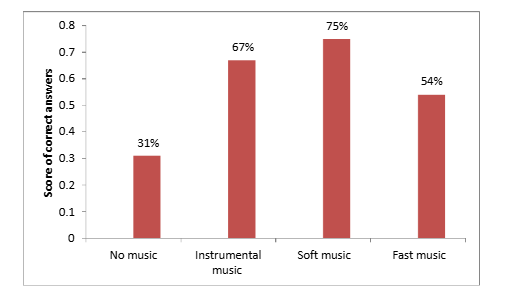
What type of Music should one listen to?
Now, what type of music should we listen to while study? This is the most critical question to address, and there is a mistaken belief that music with lyrics helps increase productivity while reading. Well, yes, it’s those; however, a significant hit is taken to your comprehension and understand. Imagine this scenario of two people talking while you are trying to read, you will feel distracted and your mind will also wander to the conversation, well, that’s what listening to music lyrics while trying to study, read or concentrate those to you. Music with lyrics is better utilised when doing mundane tasks and chores, maybe at home or at the office.
As stated in the earlier study, soft and instrumental music is the best to listen to while doing any academic or learning-intensive task to boost your focus, productivity, and comprehension. A key study by Thompson and others in 2001 found that background music, especially compositions with a tempo of around 60 beats per minute, improved concentration and problem-solving abilities. Hence, listening to classical music or instrumental music can increase dopamine levels, the neurotransmitter associated with motivation and pleasure, and enhance neural efficiency, particularly in tasks requiring spatial-temporal reasoning.
Conclusion & Advice
One great misconception of all the controversial studies online is that listening to background music doesn’t have the positive effect of boosting one’s cognitive edge. However, a closer read of all the studies that are against listening to music for learning and productivity, one realisation that will come up is that the background music that is played for the group of participants is often just relegated to being noise for them and a distraction. One key thing that stand out in Teresa Lesiuk study on the “effect of The effect of music listening on work performance’, is that they were allowed to listen to their own music individually during their work, not playing music in the background because that will be distraction & noise to others who don’t share that particular task in music be it classical or instrumental. (And understanding this is key for the next concept I will discuss in my blog, little hint NOSTALGIA.)
Hence, enjoy yourself, try to adapt music to your daily reading and study hours. When you need a boost of productivity and focus, put on some music, adjust the volume to your focus level. Music with lyrics should be recommended for mundane tasks and repetitive tasks that will aid in a more productivity flow (Such as cleaning or inputting simple information). While for a more immersed focus on reading and studying classical and instrumental music is the way to go, I personally enjoy instrumental music.